Thursday, November 02, 2006

Cool Hollywood Couple no. 472


I love Annabella Sciorra, and I didn't know she was seeing Bobby Cannavale. That makes me wildly jealous of them both. I can't wait to see her in Twelve and Holding, and him in Cuban-Italian-American Studs' Wild and Wacky Jockstrap Party. Oh wait. That's not a film.

Let's leave the kid out of it, OK?

Saturday, October 21, 2006

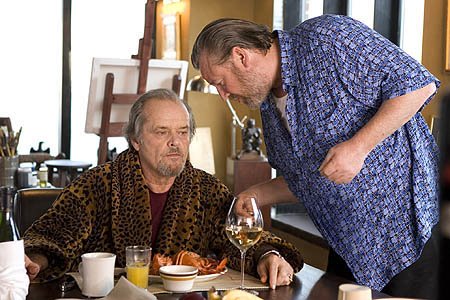
Why I Don’t Get The Departed

Read more than a handful of the glowing reviews for Scorsese’s latest and you may detect — beneath the rote praise for Thelma Schoonmaker’s slightly uncertain editing, the justified plaudits for what DiCaprio’s doing, and a whole load of starstruck raving about one of the least disciplined performances of Jack Nicholson’s career — a heavy sigh of relief. He’s pulled it off, is the implication: the movie’s no masterpiece, but it works.

Think about that for a second. Which other great American director has reached a point in his career where we’re this damn grateful for a half-decent movie? Who else labours for two years or more, from script to shoot to famously arduous post-production, on a piece of cinema whose unveiling isn’t the cause for celebration but its very opposite — apprehension? Scorsese is personally complicit, of course, in the prickly air of worry that now seems to hang over every Scorsese project. He guards his secrets like a paranoid magician: only the most trusted and friendly of journalists is allowed access to his sets. And he’s constantly described as “wary” about his films’ reception, stung so often in the past by even minor criticisms of his best work, continually a disappointment to his studios, pipped to that Best Director Oscar by idiots. Actors! Who wouldn’t get butterflies?

The real problem arises when the movies themselves seem nervous. The Departed, for me, isn’t decent but exactly half-decent — about half the film it should be, which is an odd thing to say about a picture that feels 30 minutes too long as it is. The structure isn’t there and the movie’s a shouty scrummage, albeit an often pretty entertaining one, of big scenes, flashy riffs and see-what-sticks showboating. It doesn’t quite know how to contain itself or many of its core elements — certainly not Nicholson, who barges in right from the start and upsets, not subtly, but with shoulder-blows, the yin-yang symmetry this plot is crying out for. There just isn’t room in the movie for three lead performances and Matt Damon, who’s perfectly promising in a blunt sort of way, traipses out of the saloon door with his tail between his legs.

Then there’s the half of the movie that works a treat, which is almost every scene Leo gets that isn’t opposite Jack, all the stuff with Mark Wahlberg, Martin Sheen, and Ray Winstone, and a surprising amount of the love-triangle subplot (see what I mean about scrummage?) in which Vera Farmiga acts the hell out of a nothing role. The truth is that Infernal Affairs was just as patchy and nearly as wasteful of its terrific genre conceit. Instead of cat-and-mouse intrigue — we want these guys to have each other’s number, early on, and each to be working at full tilt to outwit and dislodge the other — both movies give us straggly threads of subplot that go nowhere, and tie things up in frankly desperate fashion with the intervention of third-tier characters whose corruption (meant, sure, to be emblematic of a wholesale, institutional rottenness) is in narrative terms a shrug and a cop-out. I can think of so many cleverer, more grabby, and more subversive ways that this plot could have been worked out: it was begging for a top-to-tail restructuring, not just a relocation to Boston, a locale neither Scorsese nor most of his cast nor screenwriter William Monahan (who was actually born there) nor even great d.p. Michael Ballhaus (if we compare, say, Tom Stern’s work on the otherwise iffy Mystic River) ever seem fully comfortable in.

What I mean by nervous is that I think The Departed risks being a self-conscious recycling of pet Scorsese tropes, one that keeps looking over its own shoulder and courting approval like some kind of ageing jester. That guitar intro to “Gimme Shelter” again, for instance? And it comes particularly unstuck in the trotting out of needlessly thuggish set-pieces that break free of all psychological credibility in their attempt to gain the blackly comic edge of Mean Streets, Goodfellas and the massively underrated Casino. Not even the hard-working DiCaprio can sell his character’s ability to go tactically apeshit in a bar here: it’s just Scorsese giving us what he thinks we want. Ditto the unrelenting and exhausting stream of homophobic abuse. Pauline Kael said Goodfellas was about “being a guy and getting high on being a guy”; The Departed is about not being a faggot and getting high on calling other guys faggots. Is this authentic Boston man-speak? I don’t care. They’re all enjoying it too much. C+

Saturday, October 07, 2006

Truly Madly Wetly


What is it with Anthony Minghella and baths? Ralph and Kristin got steamy in The English Patient. Matt stirred a finger in Jude’s tub in The Talented Mr Ripley. And Breaking and Entering, Minghella’s new London-based romantic drama, from his first original screenplay since Truly Madly Deeply (1991), has two big bath scenes late in, the double whammy of which seems to me a faintly contrived way of gearing up for some naked truths. Law (the director’s continuing muse here, as an errant architect) first sloshes about with Juliette Binoche, who plays a Bosnian immigrant seamstress living with her light-fingered son (Romi Aboulafia) somewhere around the many building sites of King’s Cross. Robin Wright Penn pines away at home, usually through glass, as Law’s not-quite-wife, who’s half Swedish. The second bath is hers, and one of those where the character sits hunched forward looking pained and beautiful and presumably getting a bit cold. Minghella clearly likes his actors to bare their souls while they’re passing the soap, but neither scene wins the prize for best tub thesping in recent movies, which rightly belongs to Emily Watson’s hands, in close-up, in The Proposition.

The truth is, no one’s bad in Breaking and Entering — certainly not Renée-Zellweger-in-Cold-Mountain-bad, or Nicole-Kidman-in-Cold-Mountain-bad, or indeed anyone-in-Cold-Mountain-bad — and even when the film’s not quite working, which is often, it has some charming grace notes, many of them belonging to Martin Freeman as Law’s bemused business partner. But it’s a picture in which cleaning ladies cite Kafka and hookers donate Land Rovers as parting proof of their innate wisdom, which is to say I simply don’t buy very much of it, and the urban-regeneration-as-romantic-metaphor idea is straight out of the Stephen Poliakoff handbook for clever screenwriters itching to go location scouting. Minghella hoists his drama into place with an impressive panoply of cranes and scaffolding, but it’s left half-finished, really. Hard hats advised. C+

Tuesday, October 03, 2006

New Guest Oeuvre: John Carpenter (see side panel)


What can I say? He's made more guilty pleasures than any other director I know, except maybe Brian De Palma. We'll do him soon. Almodovar too, once I've seen a few more of the early ones...

I'll leave you with that magnificent line from the splendid They Live (above): "I've come here to chew bubblegum and kick ass. And I'm all out of bubblegum..."

God bless you John!

Thursday, September 28, 2006

Lunch-break serendipity

Sorry for all these scrappy posts. Just switched on the TV and caught the last act of Jonathan Mostow's Breakdown by accident. It's some while since I last saw it, but I maintain that, scene for scene, it's the best Hitchcockian thriller of the last ten years. Anyone with me on that? Anyone not seen it? I wish Mostow had stayed down and dirty rather than graduating to the big league with U-571 and T3. Hear he's remaking Frankenheimer's Seconds next, which might be interesting...

Forest fire


Whoah. Haven't seen it yet, but from the quotes here it looks like next year's Best Actor Oscar might be a virtual shoo-in for one of my favourite actors. I'm psyched!

Wednesday, September 27, 2006

Tuesday, September 26, 2006

On These Three and Dodsworth


Just watched These Three, William Wyler's first version of Lillian Hellman's The Children's Hour, in preparation for this Sunday's Supporting Actress Smackdown. I won't comment on the nominee in question — Bonita Granville, who plays the diabolical Mary Tilford — as it's nice to leave some surprises. But I will say that I like this version marginally less than the remake, and not just for its (actually rather judicious and cunning) bowdlerisation of Hellman's themes. Merle Oberon was a serious problem for me, for starters. The first performance of hers I've seen, it's a stiff piece of semaphore, full of repetitive touches like that little moue of knowing amusement she puts on whenever Mary's throwing a fit. Worse is that it exposes a significant weakness of the play, which is that Karen is too often a mere spectator in the scandal brewing up around her, and her suspicions about the veracity of Mary's story aren't signposted nearly early enough. Audrey Hepburn, invariably on another planet, lets us look past this in the 1961 movie; Oberon just seems to be acting out a much more stilted, slow-witted drama than anyone else. I liked Joel McCrea goofing off on the sidelines, and Miriam Hopkins is subtly strong in the more generous role of Martha; Alma Kruger is an imposing presence, too, as Mary's grandmother, if never quite managing the shading and self-reproach that netted Fay Bainter a nomination for the remake. But I don't think Wyler quite gets to the heart of the play here; the scandal lacks truly public weight and so do the recriminations.

Few such qualms with Dodsworth, Wyler's other 1936 release and now my third favourite film of his, after The Little Foxes (another Hellman, magnificently realised) and The Best Years of Our Lives. Initially I was a bit off-put by Ruth Chatterton, but blame the character: if the movie has a flaw, it's that Fran Dodsworth is unhelpfully slathered in face cream when she's getting to make a case for herself, and required to put her most self-serving, ill-considered airs on at the exact point when contrition might save her. Still, Walter Huston's Sam (and the film) give her plenty of chances. Maria Ouspenskaya is up for discussion on Sunday for her one-scene appearance as an obstructive baroness, but, leaving her aside, you can expect me to be heartily lamenting the absence of Mary Astor from the same race. As Dodsworth's widowed ladyfriend Edith Cortwright, she comes in at all the right moments and achieves the perfect balance of hope, sadness and fragile dignity to channel this splendid picture where you want it to go. She's quite wonderful.

Friday, September 22, 2006

A Durex-free future


Here's mainlymovies' first long(ish) review in a while. Alfonso Cuarón's Children of Men is equal parts brave and frustrating, I think. It feels like the first part of a series we'll never get — the backdrop's remarkably detailed, the production design Oscar-worthy, but we barely feel we've got to know any of the main characters before it's over. I heard yesterday that the Universal exec who greenlit it has been given the boot. It's unfashionably grim stuff, for sure, but flashily so — and there's the rub.

Sunday, September 10, 2006

How is the weather?

You know this lyric in The Turtles' 'Happy Together'?

"No matter how they toss the dice, it had to be /
The only one for me is you, and you for me /
So happy together..."


Now read it again. Parse it. Or, better still, listen to it. I don't know how I'd managed to miss this before, since I pretty often call this my favourite song of all time, but it's a hidden admission of unrequited love, right? "The only one for me is you, and you for me". Ouch. What about her? Does she get a say? I don't think so. The whole song's fantasising about the unattainable, surely. But what I love most is how — with the easy rhyme there, which lulls you time and again into missing the actual meaning — it seems to convince itself every time you hear it, and how that relentless march-beat escorts song and listener up, up, and over the moon.

Wednesday, August 23, 2006

Will Tim ever get his blogging groove back?


He's not sure. But Taye might help. Come on Taye, whisk me off to Jamaica or what have you.

Sunday, August 13, 2006

Mid-year stock-taking


Mainlymovies is well aware that he's been a rubbish blogger of late, what with back-to-back holidays and books to finish and other demands on his time. So to kickstart this whole thing back into something approaching life, here's a recap of what's been particularly good (and awful) over the past six months or so. List time!


The Movies of 2006 (so far)

Black Sun (d. Gary Tarn) A
Requiem (d. Hans-Christian Schmid) A—
MirrorMask (d. Dave McKean) A—
A Scanner Darkly (d. Richard Linklater) A—
United 93 (d. Paul Greengrass) A—
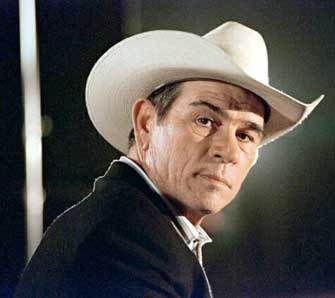
The Three Burials of Melquiades Estrada (d. Tommy Lee Jones) A—
The Devil and Daniel Johnston (d. Jeff Feuerzeig) A—
Monster House (d. Gil Kenan) B+
Strayed (d. André Téchiné) B+
Forty Shades of Blue (d. Ira Sachs) B+


Best Director

Paul Greengrass (United 93)
Tommy Lee Jones (Three Burials...)
Dave McKean (MirrorMask)
Gary Tarn (Black Sun)
André Téchiné (Strayed)


Best Actress

Emmanuelle Béart (Strayed)
Sandra Bullock (The Lake House)
Sandra Hüller (Requiem)
Stephanie Leonidas (MirrorMask)
Pauline Malefane (U-Carmen e-Khayelitsha)


Best Actor (struggling a bit here...)

Nicolas Cage (The Weather Man)
Tommy Lee Jones (Three Burials...)
Edward Norton (Down in the Valley)
Guy Pearce (The Proposition)
Melvil Poupaud (Le temps qui reste)


Best Supporting Actress

Nichola Burley (Love + Hate)
Charlotte Rampling (Lemming)
Meryl Streep (A Prairie Home Companion)
Emily Watson (The Proposition)
Kate Winslet (Romance and Cigarettes)


Best Supporting Actor

Mos Def (16 Blocks)
Robert Downey, Jr (A Scanner Darkly)
Woody Harrelson (A Prairie Home Companion)
David Morse (Down in the Valley)
Barry Pepper (Three Burials...)


Original Screenplay

Guillermo Arriaga (Three Burials...)
Neil Gaiman, Dave McKean (MirrorMask)
Dan Harmon, Rob Schrab, Pamela Pettler (Monster House)
Bernd Lange (Requiem)
Dan Wilde (Alpha Male)


Adapted Screenplay

David Auburn (The Lake House)
Paul Greengrass (United 93)
Richard Linklater (A Scanner Darkly)
Hugues de Montalembert (Black Sun)
Gilles Taurand, André Téchiné (Strayed)


Original Score

tomandandy (The Hills Have Eyes)
Nathan Johnson (Brick)
Nick Cave, Warren Ellis (The Proposition)
John Ottman (Superman Returns)
John Powell (United 93)


Editing

William Goldenberg, Paul Rubell (Miami Vice)
Douglas, Pearson, Rouse (United 93)
Rian Johnson (Brick)
Roberto Silvi (Three Burials...)
Dan Zimmerman (The Omen)


Sound

Black Sun
Brick
Miami Vice
Monster House
United 93


Cinematography

Dion Beebe (Miami Vice)
Bogumil Godfrejów (Requiem)
Alar Kivilo (The Lake House)
Chris Menges (Three Burials...)
Gary Tarn (Black Sun)


Production Design

Forty Shades of Blue
MirrorMask
Requiem
A Prairie Home Companion
Strayed


Costume Design

MirrorMask
Pirates of the Caribbean: Dead Man’s Chest
A Prairie Home Companion
The Proposition
Three Burials...


Documentary Feature

Black Sun
The Devil and Daniel Johnston
Who Killed the Electric Car?


Animated Feature

Curious George
Monster House
A Scanner Darkly


Top ten reissues:

The General (Buster Keaton, 1927) A
King Lear (Grigori Kozintsev, 1969) A
The Fallen Idol (Carol Reed, 1948) A
I Am Cuba (Mikhail Kalatozov, 1964) A
The Innocents (Jack Clayton, 1961) A
Kiss Me Deadly (Robert Aldrich, 1955) A
The Passenger (Michelangelo Antonioni, 1975) A—
Celine and Julie Go Boating (Jacques Rivette, 1964) B+
L’armée des ombres (Jean-Pierre Melville, 1969) B+
Metropolitan (Whit Stillman, 1990) B+


Worst ten movies so far this year:

The Da Vinci Code D—
The Thief Lord D—
Underworld: Evolution D—
Hostel D—
Silent Hill D—
Ultraviolet D—
Quo Vadis, Baby? F
Shopgirl F
Lady in the Water F
Get Rich Or Die Tryin’ F


And the so-bad-it’s-completely-unmissable award:

Thursday, August 10, 2006

New Guest Oeuvre: Michael Mann (see right panel)


Let's get back into the swing of this...

Sunday, July 30, 2006

Best Supporting Actress 1961


Our friend StinkyLulu has some very bad news over at his blog. Get there and give him your support. But the man is one of those tireless, unstoppable bloggers I'm in slight awe of, and I'm delighted to say that his ongoing supporting actress project isn't taking a breather even on this saddest of Sundays. I've been remiss this month in not managing to see all five of the nominated performances from 1961 — blame the unavailability of Summer and Smoke either on DVD or VHS in this country, and me being too slow off the mark to track it down elsewhere. (Thanks for the offer, though, Nick!) As a result, Una Merkel's nominated performance will have to pass without comment here (let's just say fellow supporting actress smackdowners weren't over-impressed.) Still, it was a quality year otherwise: the veteran character actress Fay Bainter, in William Wyler's second stab at adapting The Children's Hour, is rivetingly over-receptive to the vicious gossip cooked up by her granddaughter; Judy Garland acquits herself really pretty well in Stanley Kramer's all-star tribute to Nazi shame, Judgment at Nuremberg (while hardly putting brilliant Best Actor-winner Maximillian Schell in the shade); Lotte Lenya is poisonously watchable pimping out gigolos to ageing American tourists in the Tennessee Williams-derived The Roman Spring of Mrs Stone; and Rita Moreno — though this should be news to no one — is quite the best thing in West Side Story. Head over to stinky's and see what the others thought; thanks Nat, again, for the banner and the clipreel.

On a side note, more, soon, if I ever get round to a long review, on why even Kate Hudson's bearable in Iain Softley's rather overlooked Louisiana spook story The Skeleton Key, why the same movie has the best use of Gena Rowlands in donkey's years, and how it stands out in the dubious oeuvre of twist-fond screenwriter Ehren Kruger (Reindeer Games, The Ring) for being tightly ingenious, satisfyingly grim, and surprisingly witty on a second viewing. Well worth a rental folks.

Thursday, July 27, 2006

Is it a bird? Is it a plane?


No, it's an actual post on mainlymovies! I'm not all that super or anything (still, thanks for asking) but I have returned, from a long self-imposed sabbatical of holidaying and book finishing. And I intend to blog again, lots. Where are we? Supey was kind of a mixed bag, yes? Pirates a non-event, if not quite a complete waste of time. But riddle me this: how damn strange is Miami Vice? We may need to talk about this one. A great deal of it's just awful, and then... well, you should probably all see it first. Drop by and say hello everyone!

Sunday, June 25, 2006

Mainlymovies will return soon

He's in Cyprus, not watching movies. Getting sunburn. In the meantime, go to Stinky Lulu's for some supporting actress fun...

Sunday, June 04, 2006

Best of The Best

I suppose I could just pick up David Thomson, but my favourite way to get an instantly accessible overview of a director's career tends to be courtesy of all those people — many of them apparently half-mad, but bless — who cast their votes on the Internet Movie Database. Clicking "sort by ratings" — which gives you a ranked list of any director/actor/craftsperson's complete output according to each film's average mark out of ten — is admittedly a fairly tragic activity, but then so is treating the ticking off of movies as a life goal (guilty) and collecting football cards (not guilty) and any number of other male, listy things, so leave me alone.

Anyway, it can yield some surprises. What would be your guess for everyone's favourite Bergman film? The Seventh Seal (1957)? Try Shame (1968). Worst film starring Nicole Kidman? It ain't The Human Stain (an alarmingly high average of 6.29) or Days of Thunder (5.30) or even The Stepford Wives (5.20), but something from 1987 called Watch the Shadows Dance (3.83). (Apparently the 2000 Blockbuster Entertainment Awards, which voters scathingly panned with an average of just 3.03, were even less enjoyable.)

Anyway, a director I've been checking out recently is William Wyler, whose record is quite something: 29 movies, and not a single one that dips below a pretty respectable 6.8 on the "weighted" scale. (Whatever that means.) Bottom is 1935's Edward G Robinson-starrer Barbary Coast, on which Wyler was actually replaced by Howard Hawks. Hawks, Cukor and others would go green looking at Wyler's scorecard, even if his top mark (8.2 for Ben-Hur) isn't particularly stratospheric compared with, say, the upper echelons of Hitchcock or Welles.

Looking at his career this way has confirmed my sense that Wyler was one of the most genuinely reliable directors of Hollywood's golden age, if by reliability we mean a versatile craftsmanship in, out and between genres, a habit of doing intelligent justice to his given material, and a sturdy interest in recurring themes without the instantly recognisable authorial stamp of his more canonised peers. Which is to say, if you were a Cahiers du Cinema critic, you'd probably have to call Wyler a "metteur en scene" rather than a full-blown auteur, but, unless you were a particularly dogmatic one, you'd still have to allow him his own subtle signature — refined and difficult to forge, we might say, unlike the bold, easily pastiched imprimatur of a Hitchcock or a Frank Capra.

I'd differ very slightly with IMDb's rankings of the mere five Wyler films I've seen to date: Funny Girl (1968), which I still quite like, does belong towards the bottom, because though it contains, or rather struggles to contain, an almost frighteningly assured declaration of intent from Streisand (in her debut), it's typical of the stodgy, puddingy quality of late-Sixties musicals in too many other ways. I like The Children's Hour (1961) quite a lot more than Mrs Miniver (1942), basically because of sharper drama and better acting, but both are strong; and The Heiress (1949), the director's stab at Henry James's Washington Square, stands up beautifully give or take a slightly disappointing performance from Olivia de Havilland.

It's not for want of chances, but I've still yet to see Ben-Hur. The Wyler I've just got round to, third down on the IMDb list, is his WWII homecoming drama The Best Years of Our Lives, a big wham-bam Oscar grab bag in 1946, but a marvellous, bitter and plangent movie all the same, enthrallingly small-scale for a film of its epic length, and distinguished by at least two remarkable performances and several pretty good ones. Nick, for one, considers Fredric March's Oscar the most worthy ever given in the Best Actor category, at least among those he's seen; I think I'd give that honour to George C Scott in Patton by a whisker, but it's very close, with Nicolas Cage and F. Murray Abraham (curiously underrated, insofar as an Oscar-winner can be) not far behind.

Still, for all March's contained virtuosity, his caginess, his staunchly untheatrical self-pity, there was another performance which, if not technically its equal perhaps, struck me as in many ways even more impressive in terms of its centrality to the film's impact. I'm talking about Harold Russell, who plays double amputee Homer Parrish. Wyler lavishes his best work on the character right from the beginning, as do cinematographer Gregg Toland and (in one of his finest scores) composer Hugo Friedhofer, all enfolding him in a spellbindingly expressive moment of wordless vulnerability as he wakes up on his flight home and gazes out fearfully and almost beseechingly at the clouds.

I was instantly attached to Homer as a character and Russell as a performer, and so impressed by his acting that I began to doubt whether he was a non-professional war veteran as I'd initially assumed. I must admit that I'd never heard of the man, a real-life amputee who was awarded the kind of Best Supporting Actor Oscar the Academy could, in this of all years, have felt justified handing him for sentimental reasons alone. But they didn't, or at least they needn't have, on that basis. He's a wonderful, genial, touching and sad presence throughout the film and really the whole point of it. The way he modulates his pain in different company — hearty with the guys, stiff and awkward with family, almost unbearably lonely and introspective on his own — tells Wyler's whole story about rehabilitation and tells it magnificently. I found the other plotlines less compelling in various ways — Dana Andrews and Teresa Wright struggle to make their will-they-won't-they courtship sufficiently surprising, and Myrna Loy is perfectly good but oddly irrelevant — but even if the film falls just short of greatness in its last hour, it remains top-flight stuff whenever March or Russell is on screen. Overall, it strikes me as almost the summary statement of Wyler's career: shrewd, humanistic and powerfully layered, an honourable and unpretentious achievement which stands its ground, neither giving in to maudlin awards-bait theatrics nor pretending to solve all its characters' problems in one go. Ben-Hur (#1) and Dodsworth (#2) will need to be pretty damn good to beat this.

The Best Years of Our Lives (1946) A—
The Heiress (1949) A—
The Children's Hour (1961) B+
Mrs Miniver (1942) B
Funny Girl (1968) B—

Thursday, June 01, 2006

Gaslight (1940) vs Gaslight (1944), and other musings

In between bouts of intense work on this book (a DVD guide, on which more later) it's been 1940s cinema a-go-go around here, what with all those 1942 supporting actresses to watch and a couple of key Ingrid Bergman movies I've only just got round to catching. I'm not sure Hitchcock's Spellbound (1945) actually deserves to be called key, though its star acquits herself relatively well given the barmy compound of dime-store Freudianism and Surrealist chic she finds herself sifting through. Ponderously organised, slick and faddish, it's a David O. Selznick movie with occasional flashes of creepy Hitchcock wit, but it's disappointing to watch a director who only the following year, in the wonderful Notorious, would sail so blissfully through a bonkers plot making such heavy weather of the gimmickry here: the puzzle-box layering of the Gregory Peck character, in particular, strikes me as virtually unactable, though square and wooden he can manage. I'm not at all sure that the first five, remarkably prolific years Hitchcock spent in Hollywood — from Rebecca through to this, scoring him his first three Best Director nominations — aren't actually his least interesting from any period: the double threat of Selznick and WWII seemed to stifle his sense of humour, I'm not even that crazy about Shadow of a Doubt (1943), and several of the others (Suspicion, Saboteur, Lifeboat) are workmanlike and impersonal in ways that dull the edge of their promising concepts.

I had a better time during George Cukor's Gaslight, with its Suspicion-like plot, though fans of the director and the film should take note that the earlier British version, made by Thorold Dickinson in 1940 and famously suppressed by Louis B Mayer, is in every way its superior. (It even makes it into my top 100.) Bergman's well-calibrated hysterics are both the movie's trump card and its problem, since it's fashioned so opulently by Cukor as a sort of vehicle for them, Charles Boyer's smooth but oddly unimpressive heavy coming nowhere near the unforgettable taunting sadism of Anton Walbrook. Cukor gets excellent work as usual from his ladies — Angela Lansbury's marvellous debut as the slutty maid fully earned her supporting nod, and Barbara Everest is good too as the housekeeper — but I think he lacks the killer genre instincts to make this material work as well as it should: a Hitchcock, for instance, would never allow Dame May Whitty to pop by and say coo-ee at the precise moment Boyer's being violently apprehended, and where Dickinson prowls around and points his camera unsettlingly at the ceiling, Cukor's just a shade too hung up giving Ingrid her sumptuous pained close-ups instead. It's by no means bad but it's glossy in a somewhat predictable way and — at a good half hour longer than Dickinson's — it rather lets the air out.

Spellbound (1945) C+
Gaslight (1940) A
Gaslight (1944) B

Sunday, May 28, 2006

Supporting Actress Smackdown: 1942


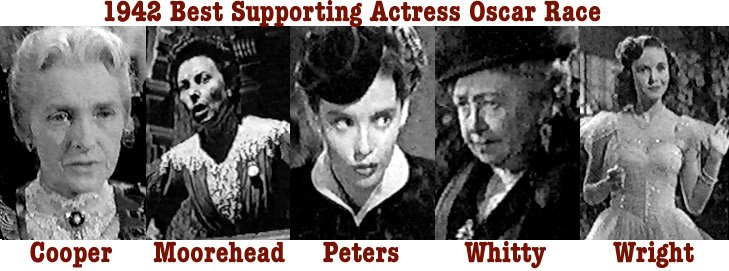
Mainlymovies has a book to finish and is nowhere close and frankly going a bit mad, but he must just pause for a minute to alert readers to the Supporting Actress Smackdown over at StinkyLulu's, in which he has had the honour of participating and which was, as predicted, a riot. The year in question is 1942, in which Teresa Wright picked up a gong for her loving war bride in Best Picture Mrs Miniver, beating Dame May Whitty in the same film, fellow home-front ingenue Susan Peters in Random Harvest, Gladys Cooper's imperious tyrant in Now, Voyager and Agnes Moorehead's unforgettable Aunt Fanny in Welles's The Magnificent Ambersons. Ok, so I've already tipped my hat there, but do tune in to find out what fellow smackdowners Stinky, Nick and Nathaniel thought of the field, and who they argue ought to have won. (Nat, whose largesse knows no bounds, has also compiled a wonderful clipreel of the contest which is well worth watching first, right through — you'll get a priceless "reaction shot" of Cooper after the decision's gone down.) More Supporting Actress Sundays, with any luck, to come — in future I'll hopefully be able to reflect on them in more detail without this deadline breathing down my neck. Thanks Stinky for bringing me on board, and thanks Nat for the time-saving banner I've stolen!

Sunday, May 14, 2006

New Guest Oeuvre: David Cronenberg (see sidebar)


I've gone a bit crazy with the As, but I wouldn't want any of those films any other way.

Sunday, May 07, 2006

Flickr-ing in hell


My photo-taking hasn't been all that prolific recently, but I'm back in the groove and planning to buy a new camera next week.

Or at least I was. The context for this pic is too painful to relate in full, but involved the unavoidable loss of £200 and possibly the most miserable Saturday night in human history. I tagged it "Simulacrum of Hell" on flickr, and I'm not even joking. (Satan, in the shape of Westminster City Council, is down the end of that corridor, roasting all car owners alive and enjoying it. Yes, it does end, but it takes nearly ten minutes to walk down, and it's somewhere deep, deep under Marble Arch.)

Friday, May 05, 2006

Friday, April 28, 2006

Susie Diamond is forever


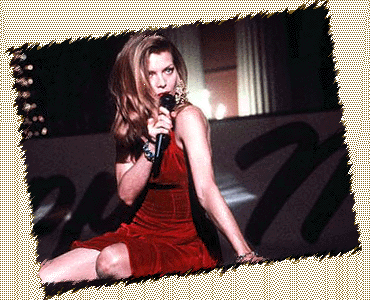
It may have come to some readers' attention that blogmate Nathaniel Rogers, over at The Film Experience, has a soft spot for Michelle Pfeiffer. He's kind of shy about this, is Nat. I really had to press him into coming out of the Pfeiffer closet this week, and, after an exhausting campaign of arm-twisting, I've managed to coerce him into organising a kind of Pfeiffer-awareness blogathon across the web today, largely as penance for what paltry coverage he's given the poor woman over the years. It's her birthday tomorrow, and she's got three new movies in production this year, and I really thought it was high time he made amends and gave her a bit of a shout out, basically.

Anyway, I jest. Nat is a Pfeiffer fan in the way that people are fans of eating, sleeping, breathing. And I like her too, very much. But there's one performance for me that towers over the Pfilmography and which I want to try and capture, just briefly. I can't imagine her ever topping her wonderful Susie Diamond in Steve Kloves's The Fabulous Baker Boys, and I don't know why she would ever need to, if the truth be told. The performance has just about everything: grace, ease, charm, wit, comic timing, magnificent allure, smoky singing, slinky moves on the piano and a totally assertive, screw-you independence. She should have won an Oscar for it. (Sorry, Jessica Tandy.)

Her breathy audition number, "More Than You Know", may be my favourite scene of an actor just standing there and singing in any film, but the architecture of that whole sequence is a perfect and incredibly generous showcase for her talents: the way she comes in, chewing gum and kind of cringing at the décor, after the Bridges brothers have just had that run of ear-splitting wannabe divas trying to belt out the showtunes. Pfeiffer's voice just melts out of her and holds you rapt. I love the close-up on Beau steepling his fingers and almost in tears. And then it's over, and she sort of steps out of the moment with a little, "Yeah, well...", and you settle in for the rest of a gloriously enjoyable and sexy movie. Others might single out "Makin' Whoopee", or the montage of the trio clambering up the hierarchy of Seattle nightspots, or the great cat-and-mouse seduction games with Jeff in the hotel suite, but it's that audition piece which pins me to my seat, every time. Can we request an encore, is what I want to know. Where's Susie Diamond now, after all?


Is she happy?

Wednesday, April 26, 2006

Sunday, April 23, 2006

New Guest Oeuvre: Stanley Kubrick (see sidebar)


Nothing below a B—, two A+s. Nearly as good as it gets, I think.

Friday, April 21, 2006

The Gospel According to St Matthew


My word. Forgive the blaspheming, but it really is a f**king masterpiece. Magnolia had better prepare to drop off the old top 100...

Wednesday, April 19, 2006

New Guest Oeuvre: George A. Romero (see sidebar)


Really quite into this. Keep on commentin' on...

Tuesday, April 18, 2006

Key Personnel: Sigourney Weaver

Veneration of all things Sigourney Weaver, probably my favourite American actress of the 1980s and 1990s, began on a first VHS viewing of Alien, was cemented by a follow-up experience of Aliens and then another and another, remained undiminished for every second of the criminally underrated Ghostbusters II (OK, I was 12), and had me looking forward to Alien³ as if Renée Maria Falconetti were returning to the role of Joan of Arc and intended to kick some serious ecclesiastical ass this time. Throughout that curious dirge of a sequel I found Weaver as riveting a presence as ever, so much more fearsome running down those prison corridors, somehow, than the alien itself, and so much more determined to claim the franchise as her own, to kill it off, even to resurrect it, six years later, on her own indomitable and fiery terms.

Alien³ is much more a Sigourney Weaver movie than it is a David Fincher movie or even an Alien movie, in a odd way, and for all its gaping flaws — wilfully ignored amid the inconceivable excitement of getting to see it, underage, with my dad at an industry preview screening about which my younger brothers were not at all happy — the film still strikes me as an important statement in its genre, a statement that was Weaver's to make and that she made with a self-sacrificial pride every bit as ballsy as the character deserved. If this series was going down, she was going down with it, basically. She's lacked hits ever since, unless we count the delightful Galaxy Quest (1999), in which she spoofed exactly the sort of role she'd refused to let Ellen Ripley ever become; I think she's extraordinary in Alien: Resurrection (1997), meanwhile, even when the movie's gloopily assaulting her with all manner of unwelcome bolted-on conceits and geeky Joss Whedon-ness. But her reign as the dominant feminist icon in late 20th-century blockbuster cinema appeared to be over, and I for one am still in mourning.

In between, I consoled myself by getting to grips with the other Weavers: bowled over by her sinewy dramatic work in Gorillas in the Mist, I forgave the movie every sin — it commits many — for allowing her to push Dian Fossey to the outer limits of audience sympathy and still make us feel the full, gutting force of tragedy at the end. Was this her, too, this smashingly strident comedienne Oscar-nominated in the same year for Working Girl? And then the fierce, bony empathy of Death and the Maiden, on which more below. Weaver's range as an actress has always impressed me enormously, and I think it's at least the equal of her Map of the World co-star Julianne Moore's; Weaver couldn't pull off the tiny emotional calibrations of a Safe, perhaps, but nor could I imagine Moore summoning the sheer fortitude, the regal poise, or the haughty, acidic outrage to do Weaver-like justice to any of the underlisted.

Five of the best:

1. Death and the Maiden (1994)

More tightly-wound and combustible than ever, Weaver stomps all over Polanski's somewhat dour film of Ariel Dorfman's play, which got a minuscule theatrical release in Britain and is still maddeningly hard to track down. Her Paulina is the whole point: damaged, dangerous, and so ferociously right that we bow our heads for doubting her sanity in the early going; that she can be this right and still this sadistic makes the second half all the queasier, and it's a performance that never for a second sentimentalises the unsightly psychological scars of victimhood or the savage, self-lacerating joy of revenge. Honestly, how an actress could have pulled out of the wreckage of Alien³ with more galvanic force and determination to prove her "serious" mettle, I couldn't say, or how one of the weakest Best Actress fields in Oscar history failed to clear space for work this sensational.
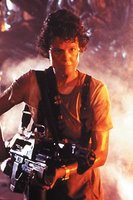
2. Aliens (1986)

Space was cleared here, on the other hand, in a "shock" genre nomination that was no shock to anyone who actually saw Aliens, which Weaver owns like a single mother owns a loudly squalling child: far more primally, that's to say, than any of her co-nominees owned their own dainty little femme-pics. Try wresting this movie away from her, just try. Ellen Ripley was suddenly not just worth rooting for but worth dying for — a magnificent bitch, a ball-breaker, an LGBTA icon to arm up with flamethrowers and go to the grave with. That "A"s for alien, by the way, as the slimy buggers seemed hardly any less smitten — an entire species dying to procreate with this one woman. They can get in line, right?
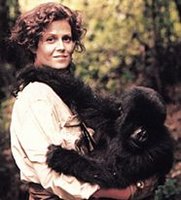
3. Gorillas in the Mist (1988)

Speaking of inter-species procreation, it gets worryingly intense in the forest glades of central Africa here, as Weaver's Fossey goes about forging a much more intimate bond with the apes than any of the token humans in her orbit, or Bryan Brown. It's the rare performance in a weak-ish biopic which is good enough on its own to make the movie worth going back to, again because of its obsessive, alienated quality, and because there's something unnervingly (poly)sexual in Fossey's very aloofness: check out the almost Darwinian contempt with which she dispatches her horny young assistants.

4. Alien: Resurrection (1997)

She's the saving grace here, of course, but way more than that: even as the movie's dissolving into gooey silliness, she gets big chances to take Ripley into fascinating new territory and plays them for all they're worth. Acid may be coursing through her veins, but I guess we always knew that; "I died", on the other hand, is a very Whedon punchline, but she delivers it with the kind of throwaway comic timing Sarah Michelle Gellar can only dream of. It's the scene in the cloning room (not the naff writhings of the finale) that really pushes the mythology forward a final notch, and golly if she doesn't make it genuinely potent and upsetting. All these half-formed Ripleys: what's left of her, even in this one? Weaver seemed to be asking the question.
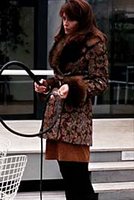
5. The Ice Storm (1997)

All that overworked ice imagery and Joan Allen chipping away at the cube tray; but it's Weaver who wouldn't thaw under the Saharan sun here, and her Janey Carver is the movie's most resolutely hard and uncompromised creation, not to mention its best casting. She seems to steer miraculously clear of all the worst, most programmatic tendencies of James Schamus's screenplay; when I think of The Ice Storm, which is not that often, to be honest, I think of Weaver twirling car keys, and then the rest of a vague, complacent, underachieved movie being whipped into shape by her every appearance.

And one of the worst:

Imaginary Heroes (2004)

Here, she's sucked, unavoidably, into utter smugness. Dan Harris's movie is such a stale, self-congratulatory slice of Ordinary People-Lite picket-fence therapy drama that not even Weaver can burst through its grim lacquer. We'll move swiftly on from her truly embarrassing pot-smoking escapade in this, and hope for bigger and much better things around the corner. All hail Sigourney!
Monday, April 17, 2006

Guest Oeuvres

A new feature I'm going to stick in the sidebar: complete (or nearly complete) rated oeuvres of major filmmakers. I'll rotate them every week or so, and I'm starting with the Coen Bros. This is to prompt discussion, mainly, so do stick agreements/disagreements/your own lists/whatever in the comments sections...

Friday, April 14, 2006

It's the funny funny feeling down... in your heart


This is a junebug. And this is how much I like Junebug.

Bask in this, guys

I love my fellow blogthren. This is perhaps an uncharacteristic show of feeling — and I'll try not to mention a single movie while I'm at it — but there wouldn't be much point to this whole business if the people checking out this blog weren't such a thoroughly remarkable and, frankly, adorable bunch. I'd like, firstly, to thank the three pints of Kronenberg I just had down the street. I'd like to thank Nick, without whom this thing would simply not exist, and who is, as well as an unimprovable human being in just about every respect, my favourite thinker and writer, on films, books, and the whole thing, in the English language. Literally. I'd like to thank Webloge, who knows who she is (which is more than I do) and puts up with all manner of flatmate shit that would send most people screaming out into the London night. I'd like to thank Nat R for being so thoroughly generous with his time and wit, linking over to me from his genuinely stellar site, and all sorts of things. I'd like to thank David S for keeping at it and never being too shy to stick up for his opinions, which literally worry me coming from someone of his modest age: how've you seen all this stuff? Damion for having a terrific blog I fail to check out nearly as often as I should do, par 3182 for being the most brilliant ironist in the smallest space, Dr S for being so obviously marvellous (and 30 today! or is it yesterday already?), ginger for taking such articulate and thoughtful interest in everything I blog about, and all you relative newcomers like ali and goran and javierag and (hey!) mylo. And anyone else I've forgotten in my half-pissed state. Sorry! You all rock. I've no idea where this came from, but you still rock.
See Junebug, by the way.

x

Friday, April 07, 2006

Tristan + Isolde = King Arthur — (romance + excitement)


King Arthur — (romance + excitement) = — (romance + excitement)

You do ye olde math.

Monday, April 03, 2006

Be afraid... be very afraid

I haven't yet blogged about my favourite performance on the West End stage in the past year or so, and, as I walked past the poster for the umpteenth time on my way home tonight, I realised that it's about time. Anthony Page's revival of Albee's Who's Afraid of Virginia Woolf? was nominated for a sheaf of Tonys on Broadway, but its single win was absolutely in the right place: Bill Irwin's George is breathtaking. He seems to seep onto the stage, this thin, grey man who you hardly reckon is going to stand a chance against Kathleen Turner's blowzy hurricane of a Martha, but there's something instantly deadly beneath his self-effacing urbanity, and an instinct for self-preservation — through the slow setting of traps, the maliciously delayed rolling out of the same old score-settling strategies — that you realise is, in a horrid kind of way, his life's work. There's such dry wit and intelligence to this performance, and yet such a vivid sense of a tragically shrivelled worldview: Irwin gives us a man who has somehow pinned himself inside his own smirking vocabulary. I loved the way he lets drop his punchlines — "That's just blood under the bridge" — with the faint but unmissable smugness of aperçus he's rehearsed to himself a million times over. I loved his gangly command of the stage, his slightly ghoulish rictus when there's a big point to be scored and he knows it. Irwin's face on the billboards never fails to elicit a smile from me, a shake of the head, and, a few paces further down the street, a shudder.

Sunday, April 02, 2006

Shooting Dogs


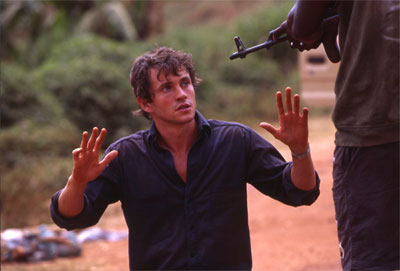
Completing this week’s Michael Caton-Jones double-header, the BBC-funded Shooting Dogs couldn’t quite be called a feel-good Rwanda movie, but it’s a feel-better one, not so much bringing home the impact of genocide as framing it and sticking it tastefully on the wall. Where Hotel Rwanda and Sometimes in April had the dramatic heft to elicit, in their different degrees, the apposite feelings of helplessness and outrage, Shooting Dogs limits itself to displaying them; our white, Western audience identification figures aren’t sensibly off to the side here but up close, frontal and quivering. Imagine Cry Freedom with both lead roles played by Kevin Kline, or ponder again the ideological evasions of The Constant Gardener and The Interpreter, all part of this same worthy but unexacting genre of African apology cinema. Questioning our own desire to make a difference is all very well, except when it ends up dignifying the viewer with a capacity for heroic empathy more than it properly confronts us with the cost of our inattention; sober and sermonical, Shooting Dogs spends 90 minutes setting John Hurt’s weary priest up as a convenient martyr in white robes, lets Hugh Dancy’s idealistic teacher off the hook for at least trying, and culminates, egregiously, with forgiveness and something close to gratitude. C